Anthropology of "Mời"
The Vietnamese Tradition of Inviting Others Before Yourself
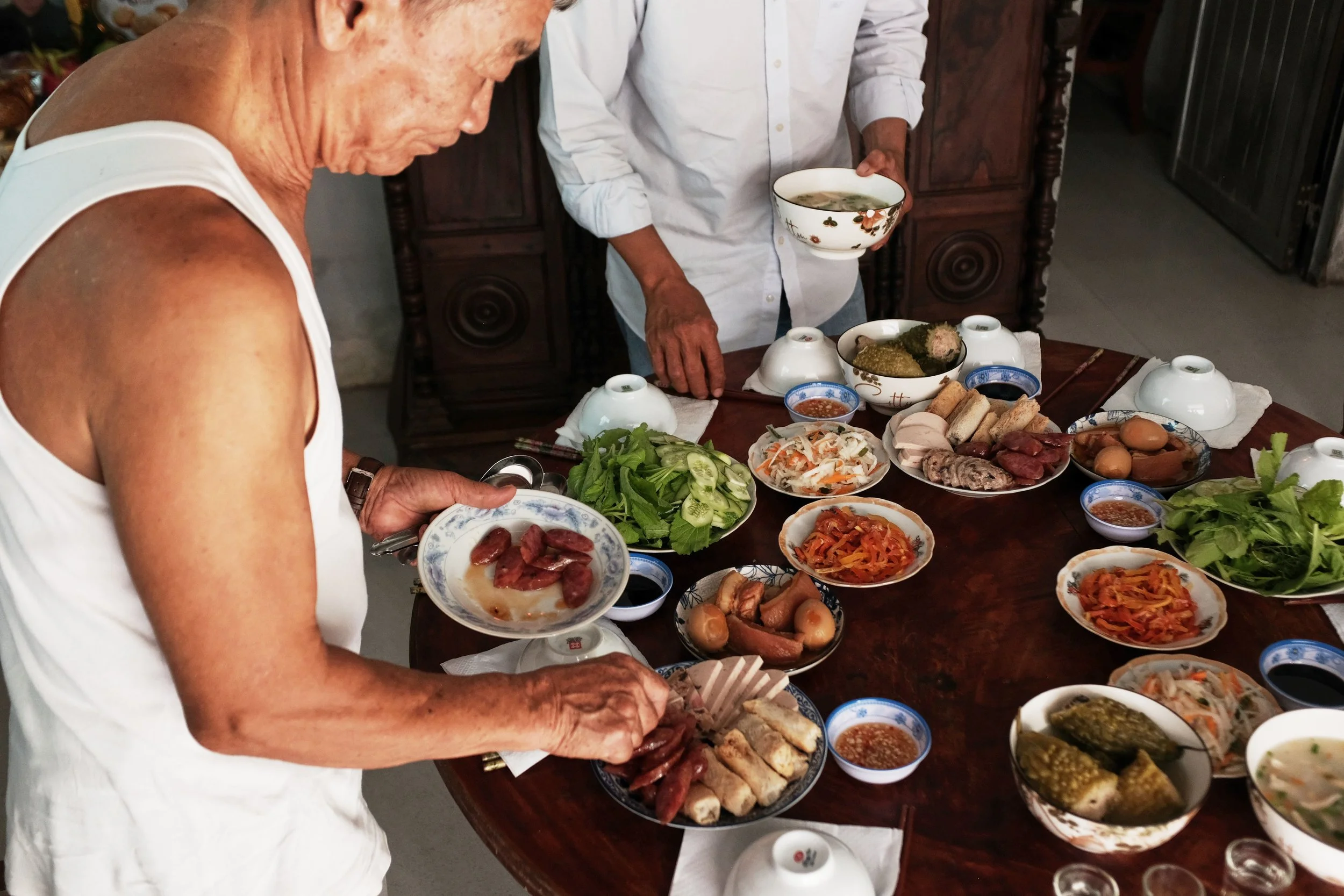
There is a moment that happens in many Vietnamese homes before the first bite of food is taken.
A child looks around the table.
"Mời ông."
"Mời bà."
"Mời ba."
"Mời mẹ."
Only then does the meal begin.
To many Vietnamese, this ritual feels so ordinary that it rarely invites reflection. It is simply what we do. Yet anthropology reminds us that the practices we consider ordinary often reveal the deepest structures of a culture.
The tradition of mờiis one of them.
Far from being a simple expression of politeness, mờireflects a broader Vietnamese worldview in which relationships are acknowledged before individual action.
More Than an Invitation
The Vietnamese word mờiis commonly translated as "invite."
While technically correct, the translation is incomplete.
When someone says mời ăn cơm, they are rarely extending an invitation in the literal sense. The meal has already been prepared. Everyone is already seated.
Instead, mờifunctions as a ritual acknowledgment.
It recognizes the presence of others before satisfying one's own needs.
Anthropologists describe these small, repeated behaviors as ritualized social practices. Their purpose is not efficiency. Their purpose is to reinforce values.
Every meal becomes an opportunity to rehearse what matters.
Relationships Before the Individual
Anthropologists have long observed that cultures differ in how they organize social life.
Some emphasize individual autonomy. Others prioritize relational identity.
Vietnam has historically belonged to the latter tradition.
Influenced by centuries of Confucian philosophy, family hierarchy has shaped everyday interaction through language, ritual, and etiquette. Respect is not reserved for formal ceremonies. It is practiced repeatedly through ordinary moments.
The act of saying mờibefore eating demonstrates this principle.
One does not simply begin.
One first recognizes everyone else at the table.
The meal therefore becomes more than nourishment. It becomes an affirmation that relationships precede individual desire.
The Family Meal as Social Architecture
Anthropologist Nir Avieli describes the Vietnamese family meal as a system of commensality, the social act of eating together. Shared meals reproduce family relationships not only through conversation, but through the rituals surrounding them (Avieli 2012).
Mờiforms part of that ritual.
The words themselves do not change the meal.
They change the meaning of the meal.
Children learn that eating is never entirely individual. Before taking from the shared dishes, they first acknowledge the people with whom they share them.
This seemingly simple act quietly teaches reciprocity, gratitude, and belonging.
Culture is not only taught through explanation.
It is practiced through repetition.
What Happens When We Stop?
Anthropologists often learn as much from absence as presence.
As Vietnamese families have become increasingly urbanized and globally dispersed, daily meals have changed.
Work schedules overlap.
School ends later.
Families live across different cities and countries.
Many households no longer gather around the dinner table every evening.
As these rhythms shift, rituals like mờican begin to disappear, not through rejection, but through circumstance.
When the shared meal becomes less frequent, the opportunities to practice its accompanying traditions also become fewer.
Yet the value behind mờiremains as relevant as ever.
Perhaps even more so.
Mời in the Diaspora
For many Vietnamese families living abroad, preserving culture often feels overwhelming.
Parents worry about language loss.
Children navigate multiple identities.
Traditions compete with busy schedules and unfamiliar environments.
It is easy to assume that cultural preservation requires perfection.
That every dish must be authentic.
That every celebration must follow tradition exactly.
Anthropology offers another perspective.
Cultures survive because they adapt.
A family gathered around pizza, pasta, or sandwiches can still pause before eating.
A child can still look at their grandparents and quietly say,
"Con mời ông bà ăn cơm."
Even if the meal is not traditionally Vietnamese.
Even if the conversation happens in two languages.
Even if the table sits thousands of kilometers away from Vietnam.
The ritual remains.
And with it, so does the value.
Small Rituals Build Cultural Memory
One of anthropology's central insights is that cultures are not preserved primarily through monuments or museums.
They survive through ordinary habits repeated across generations.
The words we speak.
The way we greet one another.
The order in which we eat.
The rituals that seem too small to matter.
Mờireminds us that culture is rarely found only in grand celebrations.
Sometimes it exists in a single word spoken before the first bite of dinner.
A word that quietly says:
"I see you before I see myself."
Perhaps that is why this tradition continues to endure.
Not because someone insists upon it.
But because every time we practice it, we teach the next generation that family begins with acknowledgment.
And that some of the most meaningful traditions are carried not through extraordinary moments, but through ordinary meals shared together.
References
Avieli, Nir. 2011. "Eating Lunch and Recreating the Universe: Food and Cosmology in Hội An, Vietnam." In Everyday Life in Southeast Asia, edited by Kathleen M. Adams and Kathleen Gillogly. Bloomington: Indiana University Press.
Avieli, Nir. 2012. Rice Talks: Food and Community in a Vietnamese Town. Bloomington: Indiana University Press.
Luong, Hy V. 1990. Discursive Practices and Linguistic Meanings: The Vietnamese System of Person Reference. Amsterdam: John Benjamins Publishing.
Luong, Hy V., ed. 2003. Postwar Vietnam: Dynamics of a Transforming Society. Lanham, MD: Rowman & Littlefield.
Wierzbicka, Anna. 2003. Cross-Cultural Pragmatics: The Semantics of Human Interaction. Berlin: Mouton de Gruyter.
Reflection
Do you still say mời before eating?
If so, who taught you, and what does that tradition mean to you today?